
These posts examine modern psychiatry from a critical point of view. Unfortunately, mainstream psychiatrists usually react badly to any sort of critical analysis of their activities, labelling critics as “anti-psychiatry,” whatever that is. Regardless, criticism is an integral part of any scientific field and psychiatry is no different. As it emerges, there is a lot to be critical about.
If you like what you read, please click the “like” button at the bottom of the text, it helps spread the posts to new readers. If you want to comment, please use the link at the end rather than email me as they get lost and nobody sees them.
****
We’re constantly told that mental disorder is increasing rapidly due to something called “the stress of modern living.” Nobody knows what “stress” is. It’s either something external that happens to you, or your internal response to an external event. In practice, the internal response equates with anxiety, and the external event is anything that causes anxiety, which is not very enlightening. Unfortunately, mainstream psychiatry doesn’t take anxiety seriously. For them, mental disorder divides in two. There’s the serious stuff that is all genetics, and there’s anxiety which is just the “worried well” carrying on about nothing. The biocognitive model says that approach is wrong on both counts. Anxiety is critically important in understanding mental disorder. If we look at what’s called a “stress response,” meaning the response to an external stressor, then a very characteristic picture emerges. Physiologists measure what they call arousal, which is more or less what you think it is, the difference between being drowsy and highly alert. If we graph a person’s performance on any task against arousal, the result is the classic Yerkes-Dodson curve (see [1]):
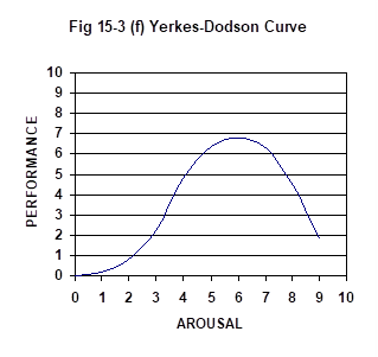
At basal arousal, when you’re asleep, blood pressure is low, pulse rate low, muscles are flaccid and the EEG (brain waves) pattern is slow and synchronous. Naturally enough, performance at any task except snoring is zero. If arousal goes up one unit, performance doesn’t go up very much at all, which we all know from the unpleasant experience of waking and starting the day. As the arousal rises, meaning the person becomes more alert, so too does the performance, except performance improves faster and faster, until a maximum point. After that, arousal can keep going up and up but performance plateaus, and then starts to fall. That phase, from about pt (7) on the graph, is what we call “mental breakdown,” meaning the person is highly agitated, shaking, heart racing, sweaty, and the EEG pattern is fast and desynchronised. People complain of racing thoughts, patchy memory, stammering, poor concentration and a sense of impending doom. They feel terrified and often say that a full-blown panic attack is the worst sensation you can experience and still survive.
This is the human version of the universal threat response, aka “fight or flight response.” Every animal has a distinctive way of sensing danger, such as seeing, hearing or smelling the threat, but humans are different in that we can also imagine threats. A threat is always in the future, it’s coming at you; you can’t be fearful of the past, only of the future. We routinely respond even when they are purely mental with no physical signs, e.g. getting panicky today over the threat of a big exam or a court case tomorrow. When we expect trouble, we react to the thought as though it were actually happening, which animals very sensibly don’t do. Because high levels of anxiety are intolerable, people have to do something to control it. Some people drink or use drugs, some get into fights, some join a monastery or play computer games all night, some are promiscuous or gamble or eat or travel or fuss over everything, there’s no limit. I’ve set all this out in the Anxiety book (see below).
Anxiety has to be taken seriously. The second point on which mainstream psychiatry is wrong is the question of genetics. For them, all mental trouble is genetic, even when there’s no evidence: it’s just a matter of spending more money and more time and eventually, they’ll find the answer. Except anxiety isn’t following the rules, it’s much more influenced by early life events which can extend well beyond the family. Early life stresses, adverse life experiences, childhood abuse and neglect, call it what you will: if a child’s life is disturbed, then there will be mental and social consequences reaching far into the future.
For anybody who spends the time to take a proper history from mentally-troubled people, this is hardly news. The quality of early family life is critically important in deciding how that person will manage in the future. The biocognitive model says that the rules we learn as a child, about ourselves and the world in general, are major influences on how we react to daily events for the rest of our lives. This model is far more flexible than the crude genetic model preferred by psychiatry. It says that two siblings with no relevant family history of mental disorder exposed to the same life events can have dramatically different outcomes or vice versa, different adverse experiences can produce the same clinical picture. This is also true of adults who experience severe psychological stressors, producing what is now called PTSD (this is a really stupid name, it means “the disorder that comes on after psychological stressors of traumatic intensity,” it doesn’t mean there is some mysterious fluid in the body called “stress” which goes up and down). After major stressful events, people acquire damaging new rules or beliefs about themselves and the world, and those rules control how they react to events.
However, beside genetics and psychology, there has always been another possibility called epigenetics, defined as “the study of changes in gene expression that occur without altering the DNA sequence.” Genetics is concerned with the actual DNA and mutations but epigenetics studies minor changes in how DNA is packaged and readied for use. These changes are generally acquired during life and most are not handed on in reproduction. The problems have always been the technical difficulty of studying tiny brain areas, and that there are too many variables for even computers to manage. However, there’s progress. A recent paper [2] used a variety of gene manipulation techniques to conclude that early life stressors can produce long-lasting epigenetic effects that influence how the individual will react to later life events. In mice.
Like all genetic research, this paper is dense with statistics and jargon and the authors found what they were looking for. They submitted normal mice, both adult and juvenile, to what mice deem stressful events, specifically social defeat. In biocognitive terms, this means that the animal is pushed around by a dominant animal and so goes down the dominance hierarchy. A defeated or oppressed animal acts very differently from the animal that defeated it. Again, the reaction to losses of this type is very characteristic for each species. In their mice, the researchers found evidence of epigenetic changes in the brain stem, one of the most complex parts of the brain (and, in mice, exceedingly small, about 0.09gm in weight). They then used a variety of gene-transfer techniques to see how this comes about, concluding that epigenetic effects in the brainstem can predispose to later mental instability. To make it more difficult, the same brain areas involved in later sensitivity to stressors are active in responding to what they called “positive, enriching experiences.” That’s not unexpected, nerves in the brain transmit or process information, they don’t secrete mysterious fluids.
Interesting. The biocognitive model sees anxiety, the response to the perception of a threat, as a major factor in all mental disorder. It is cognitively mediated but it has clearly defined effects on both bodily function and mental performance. The threat can be inside the person or it can be outside but it is always in the future and coming closer; the closer it comes, the higher the arousal level. All of this is true of animals except they never worry about exams. Similarly, depression is the response to the perception of a loss. Again, this is strongly influenced by biology in that young animals separated from their mothers become agitated, then sink into a withdrawn and apathetic state. In humans, the cause is the mental perception of a loss. Just as there are brain centres that, if activated, trigger the anxiety response, so there are brain centres which mediate the sense of pleasure and enjoyment. If they are paralysed by a loss, then the person sinks into a withdrawn and apathetic state in which nothing is pleasurable or enjoyable. This could be because those centres are actively blocked each time the person thinks of the loss (a hundred times a day) or because the original sense of loss causes some mechanism like a temporary epigenetic change, but the outcome is the same. Trying to make a depressed person laugh doesn’t work because those brain centres are under blockade.
Anyway, how this very complex research squares with the original genetic model isn’t discussed, nor whether the untold billions that have been spent on it have been worthwhile. Geneticists are all absolutely convinced, to near-delusional intensity, that the “cause” of mental disorder lies in the genes, although they have never offered a single suggestion as to how genes translate into thoughts, beliefs and emotions. This is not trivial. I can buy a new computer and know everything about it, processor speed, memory capacity, how it actually processes information etc, but that will tell me absolutely nothing about the information it eventually holds: information, either in a computer or a human, is not physical. This sort of thinking confuses the mechanism of information processing with the informational content being processed. These are matters of a totally different order of nature, subject to different laws.
The problem is far-reaching. The leader of the 19 authors of this paper, Meaghan C Creed of Washington University (WU), St Louis, is a major researcher with the National Institute of Drug Abuse (NIDA). Over the past six or so years, she has received grants in excess of US$12million to study the physiology of opiate addiction (go here for info on grants and researchers and here for Creed’s grants). Specifically, she studies why people persist with opiates even when the addiction is aversive, i.e. ruining their lives and health (that’s what addiction means, actually, and it’s biological/psychological). In classic psychological theory, punitive responses to a behaviour should eventually stop it, but opiate users just keep going because the withdrawals are so bad, same as for psychiatric drugs. WU in St Louis was where the idea behind DSM-III came from, that all mental disorder is biological/genetic. The director of NIDA is a Dr Nora Volkow, appointed in 2003. Her entry on their site reads:
Dr. Volkow’s work has been instrumental in demonstrating that drug addiction is a brain disorder ... (she) has published almost a thousand peer-reviewed articles, written 113 book chapters, manuscripts and articles, co-edited Neuroscience in the 21st Century and edited four books on neuroscience and brain imaging for mental and substance use disorders.
Volkow qualified as a psychiatrist but has always worked in research and administration. She is implacably convinced that all mental disorder is biological, and all their research money goes to fundamental neurophysiological research. She hasn’t published 1000 papers, she has had her name attached to them after she glanced at the protocol and made a few suggestions, e.g. that Creed’s work with gene transfers in mice would interest people working in depression. Neurophysiology is not a big field, these people go to lots of conferences, they all know each other and, as the keeper of the purse, everybody wants to speak to the director of a national institute. If you want research money to advance your career, you’d better be very polite to the director and definitely don’t argue otherwise you’ll simply be frozen out. You see how all of this is self-reinforcing. The conferences they go to and the papers they publish are all totally biological. NIDA’s research on social factors in addiction consists of looking at the stigma and discrimination drug users experience. Not family factors, not unemployment or domestic violence or spells in prison or racial discrimination, just people whispering and grinning behind their backs.
The point of this paper is that it is following the standard course for biological research in psychiatry: sudden announcement of a major development (in this case, epigenetics compared with formal genetics); great excitement and lots of publicity for the researchers; more money; other people can’t duplicate the results or they go nowhere; slowly fades from view until the next big announcement. Of more interest, does this sort of research signal the end of genetics in psychiatry, even of biological psychiatry itself? Don’t count on it. The Big Names in psychiatry have all established their reputations on reducing mental disorder to brain disorder. The idea that they could suddenly announce that program was all wrong and apologise for leading the world up the garden path is laughable (see Peter Gotzsche in this week’s MIA for his view on the intransigence of the psychiatric establishment).
25 years ago, the human genome was all the rage. Oh boy, they said, this will tell us everything we need to know about mental disorder. All this genetic info will allow us to design specific drugs for psychiatric diagnoses and then the scourge of mental disorder will fade into the past like leprosy. Except it hasn’t: mental disorder is still here, suicide rates are going up, ADHD has gone from a rarity to 12% of the population, ASD is out of control, depression is the biggest single burden of illness in the world and so on. Over the next few years, we can expect the researchers to quietly drop their search for the “mental disorder genes” and transition to epigenetics, which is vastly more complicated.
Meantime, the idea that mental disorder could have a mental origin is squeezed out, ignored, laughed at. However, one good thing may come out of it: mainstream psychiatrists may feel encouraged to start to take a proper history, looking specifically for adverse early life experiences. They won’t know what to do with the knowledge, but at least the patients may feel they’ve had the chance to talk about bad things from the past. And who knows, maybe some psychiatrists will start to get the insight that how you turn out in adult life is strongly influenced by family background and school experiences, as in “There but for the grace of God go I.” We can hope.
References:
1. McLaren N (2018). Anxiety: The Inside Story. (see below).
2. Kim HJJ et al (2026). Early-life stress alters H3K4me1 in VTA to prime stress sensitivity. Neuron (2027) 115: 1-14, https://doi.org/10.1016/j.neuron.2026.07.018
3. McLaren N (2021): Natural Dualism and Mental Disorder (see below)
****
My critical works are best approached in this order:
The case against mainstream psychiatry:
McLaren N (2024). Theories in Psychiatry: building a post-positivist psychiatry. Ann Arbor, MI: Future Psychiatry Press. Amazon (this also covers a range of modern philosophers, showing that their work cannot be extended to account for mental disorder).
Development and justification of the biocognitive model:
McLaren N (2021): Natural Dualism and Mental Disorder: The biocognitive model for psychiatry. London, Routledge. At Amazon.
Clinical application of the biocognitive model:
McLaren N (2018). Anxiety: The Inside Story. Ann Arbor, MI: Future Psychiatry Press. At Amazon.
Testing the biocognitive model in an unrelated field:
McLaren N (2023): Narcisso-Fascism: The psychopathology of right wing extremism. Ann Arbor, MI: Future Psychiatry Press. At Amazon.
The whole of this work is copyright but may be copied or retransmitted provided the author is acknowledged
How do these kind of studies touch reality also? It's not like there is any feasible way now (and probably ever) to make this practical. i.e. if someone asks for help, they cant operate on their epigenetics to remove a "scar".
Its like the fMRI studies etc in psychology-in real terms these studies are done with samples of 20-30 people, then coarse voxels (thousands of pixels) are statistically analyzed so the neurosciences can decide "what" it means and then say "more research is needed" to do the same useless research.
Presumably the Laughlin fellowship of the College of Psychiatrists where Volkow won a research post place looks very much as though it is one of the legacies of eugenicist Harry Laughlin
https://en.wikipedia.org/wiki/Harry_H._Laughlin
Her dedication to genetic causes of mental illness seems to be continuing Laughlin's convictions