
One of the most distinctive features of humans is our ability to communicate by symbols, collectively known as language. Normally, we use language to convey a precise meaning to those around us, as in “Look out for that croc,” or “Don’t eat that, it’s poisonous.” However, that also gives us the power to deceive people, to tell lies and lead them away from the truth. A lot of people put a lot of effort into lying just so they can gain an advantage of some sort. Working out when people are lying is a big deal, so important that it’s written into the Criminal Code, but it seems that with the internet, the scope for lying and cheating has expanded exponentially. We all have to be alert to scams and misleading advertising and fake news and propaganda and so on. It’s becoming harder and harder to know what’s true and what’s not, but also more important.
Needless to say, philosophers have been concerned with the idea of truth and falsity for thousands of years, which suggests they haven’t managed to get it right in all that time. Nearly 40 years ago, Harry Frankfurt, a philosopher at Princeton University, proposed that in addition to the well-known categories of true and false, we need to make room for a third [1]. What he called bullshit is neither all true nor all false because, to bullshitters, it doesn’t matter. Their interest is not to communicate facts, be they true or false, for the audience to believe but to sway them emotionally, to incline them to a particular viewpoint.
A few years later, in 1989, a writer named William Lutz published a book about how language can be used to that end [2]. In Doublespeak, he described how people use language to give the impression of communicating when they’re not saying anything at all. The name is adapted from doublethink in Orwell’s 1984. In doublespeak, speakers may be deliberately misleading without actually lying, or because they think they’re saying something important when they’re just mouthing platitudes. Lutz saw four categories of doublespeak. The first is euphemism, where an offensive or shocking expression is replaced with something mild. The comedian George Carlin made fun of how we try to hide reality. In World War I, soldiers who suffered mental breakdowns because of the terrible conditions were suffering Shell Shock. Two blunt syllables. In World War II, the same condition was renamed War Neurosis, four milder syllables. By the Korean War, it had become Combat Exhaustion and by Vietnam it had become Post-Traumatic Stress Disorder (PTSD), practically a whole sentence to conceal the fact that humans have mental limits and war reliably pushes them over their limits, from which there is no return. We see another in psychiatry where people suffer severe withdrawal symptoms after stopping antidepressants, which the drug industry and their friends have relabelled “discontinuation syndrome.” It still means withdrawal but without the connotation of addiction.
Next is jargon, where the speaker uses highly technical language in such a way as to impress the audience who don’t actually know what’s being said. What Lutz called gobbledygook is the politician’s specialty, talking around, over, beyond and beside the point without actually addressing it. Politicians and White House press secretaries are masters at this art form. They create the illusion of depth and expertise but on close examination, it’s all hollow talk, beating their gums for the purpose, as much as anything, of making sure nobody else gets a chance to ask penetrating questions. Finally, Lutz identified inflated language whose purpose is to make the ordinary sound extraordinary, the boring interesting, or the unnecessary seem essential. Advertising agencies and political parties specialise in this.
I mention this because I’ve just read a “special edition” of Psychiatric Times, a drug industry-sponsored throwaway with two articles on anxiety and related disorders. Where do we start? Probably the best place is with one of the senior authors, Charles Nemeroff. Nemeroff has been one of the Big Noises on the US psychiatric scene for decades, involved in writing some 850 papers and attracting untold millions in research money and fees over the years. Trouble is, some of that was finding its way into his pocket so he was ejected from the department he had built up in Atlanta, although he’s now holding forth at University of Texas, Austin, all sins apparently forgiven.
Nemeroff had a PhD in neurobiology before he started medical school, so we can be fairly sure of his orientation (perhaps he had a rich uncle as he was a student until he was 32). It’s important to remember that the Nemeroffs of the world are not psychiatrists in any practical sense. They’re serial entrepreneurs and empire builders, politicians, back room manipulators and influence peddlers, and relentless self-publicists. For them, human misery is the raw material of their various industries but not something they like to handle. They’re a bit like the lady who runs the local garden business which sells cow manure. She knows all the grades of manure, where to get the best, the price and uses and so on, but she won’t actually touch the stuff.
Now it may sound as though I’m knocking Nemeroff but this is important because his was the sort of career that shaped psychiatry into what it has become. You may think it’s just a matter of chance that we live in an age where biology dominates the discourse but that’s not true. Psychiatry was kicked, beaten and dragged into the realm of biology by hyperactive operators who were convinced all this mental talk was a load of cow manure. What did they know about the mind? Nothing. What did they feel they needed to know about the mind? Less than nothing. Did they ever think that their education in biology wouldn’t give all the answers to mental disorder? Don’t be silly, they’re scientists. Real scientists just know that their scientific method will tell us all we need to know with no worthwhile questions unanswered. If it doesn’t answer a question, it was case of a dumb question, not that their scientific method could be applied to the wrong material. It had the form of a question but no actual content, like a child asking “How high is the sky?”
So, armed with a very one-sided education and the sublime self-confidence it breeds, Nemeroff and his ilk wrote themselves a plan to reduce mental disorder to biology. The plan was called DSM-III [3], from 1980, and it introduced the idea of categories of mental disorder which they had borrowed from general medicine. Categories are separate and distinct groupings, so that each member of a category is more like the other members than it is like a member of another category. Ideally, there is no overlap, as in a case of hepatitis and a case of a broken leg. They are separate entities with practically nothing in common, although a person with hepatitis can also have a broken leg at the same time. That’s called comorbidity and the word itself says “causally unrelated” even if one diagnosis led to the other (e.g. he broke his leg at work and then got hepatitis from a contaminated needle).
Now people might object, saying that DSM-III was purely a classification of mental disorder, and that’s partly true. It is indeed a classification, but not pure. The hidden agenda was to provide a framework for biological research, to create categorical cubby holes such that each separate and distinct mental disorder would map down to a specific defect in the genome. Then the terribly clever people in the drug companies would be able to develop a unique drug for each separate disorder, and so the problem of mental disorder would be solved. Except, 45 years later, it’s clear that the entire project, the “biologisation of mental disorder,” is failing. Well, it’s clear to everybody but the fanatical “serial entrepreneurs and empire builders, politicians, back room manipulators and influence peddlers, and relentless self-publicists” who have taken control of the show, especially the purse strings.
For example, after 60 years immersed in biology, Charles Nemeroff (who is a close friend of the neurobiologist and former director of NIMH, Thomas Insel) simply cannot consider he may have been wrong all along. The biology of mental disorder is Nemeroff’s life, it’s his career, it’s his fortune and, he certainly hopes, his legacy. Asking him to reconsider the mentality of mental disorder would be like asking the Pope to convert to a prosperity gospel church. And that analogy is not wrong: with all due respect to His Holiness, he believes Catholic doctrine but he can’t prove it. Nemeroff and Co. believe biology will explain mental disorder but they can’t prove it either.
The two articles in Psychiatric Times show their project is failing but a first or superficial reading won’t reveal this because it’s all buried under a layer of doublespeak (cow manure, if you prefer). The first sentence of Nemeroff’s article sets the tone: “Anxiety and traumatic stress are as ancient as the human limbic system but have recently taken the public spotlight.” They don’t define anxiety, they don’t define “stress” and straight away, they’re talking in biological jargon. The word “stress” is now meaningless but it should never have snuck into psychiatry in the first place. It comes from a Hungarian-Canadian researcher named Hans Selye (1907-1982), who wanted to write a general theory of biological response to external pressures. He borrowed the concept from engineering but, because his English wasn’t perfect, he mixed up the words stress and strain.
In engineering, the stress is the external pressure applied to a structure; the strain is the internal response. So now psychiatry is stuck with the idea that the external event is stress (“There’s so much stress at work”) and the internal response is also stress (“I’m full of stress today”), which isn’t helpful. To make it worse, they try to draw a line between “stress” and “anxiety,” which is totally confusing because, by definition, the mixed psychological and physiological response to an external event just is anxiety. They’re one and the same thing, except that doesn’t fit the reductionist biological model because that would say that some mental disorder is psychological, not biological. Instead of discarding their model (see above re popes changing churches), they conceal their confusion under a layer of jargon and gobbledygook:
Anxiety and traumatic stress overlap phenomenologically—both involve typically increased levels of arousal and impaired interpersonal and occupational functioning. Moreover, biologically, many of these features derive from a shared maladaptive limbic system, or autonomic outputs that produce amygdala activation and/or elevated sympathetic drive. They nonetheless differ in their causes, degree of neuroendocrine dysregulation, and presenting symptoms …
The article wanders all over the place, but their problem is clear: they need to show a difference between unprovoked “anxiety” and the response to an external stressor. They need to because that’s what their theory says. However, it’s wasted effort as they’re one and the same thing: the definition of anxiety is “the response to the perception of a threat,” but what is an external psychological stressor? A threat.
Aha, they will say, but what about an anxiety state like social phobia, which the person experiences even though there is no threat? Surely that proves it must be biological? No, it doesn’t prove anything of the sort. All it proves is that anxious people, e.g. with social phobias, switch on their anxiety response too often and too intensely just because they see social interaction as a threat (i.e. anxious people interpret neutral events in the environment as a threat, and respond accordingly; the first step in the sequence is a mental misinterpretation, not an overactive limbic system, that’s secondary). This explains why the authors can’t come up with a biological cause for anxiety states: there isn’t one. It’s all psychological. People with social phobias don’t see other people as the threat, they’re scared of their own inner states, as in:
If I have to mix with those people, I’ll feel terrible and start to shake and sweat and stutter; if they see me shake and stutter, they’ll think there’s something wrong with me; the thought that they will think I’m a weirdo is very scary; scary thoughts make me shake and sweat and stutter, and here it comes. Oh dear, now I feel terrible, I must be about to have a really bad attack; that thought scares me even more. I can’t go in, I’ll have to go home and feel like an even bigger failure.
Mixing with people is not the threat, it’s the thought of how the individuals will feel when mixing with people that is the threat. They expect to feel bad, which is itself a scary thought; by definition, scary thoughts make them feel anxious; and feeling anxious is horrible, which is what they expected and therefore closes the vicious circle. This is true of all the anxiety states which focus on performance, including sexual performance (which is much more common than people think). That is, we can give a perfectly sensible explanation of anxiety states as a purely psychological phenomenon, with no hint of brain damage or bad genes or anything: it’s genuinely all in the mind but, because it’s a true vicious circle, the person stuck in the middle can’t see it. The psychiatrists, of course, are all looking for something else so they don’t see it. Did I mention Yogi Berra last week? I did: “It's amazing what you don't see when you don't look.” If you’re not looking for psychological causes, you won’t see ‘em. Especially if they’re subtle and deep-seated vicious circles.
Briefly, the second paper was a rambling mishmash on trying to see the difference between Borderline Personality Disorder (BPD), Post-Traumatic Stress Disorder (PTSD) and what is now called Complex Post-Traumatic Stress Disorder (C-PTSD). Spoiler: There’s no difference, the symptoms are exactly the same. The only difference is how they’re worded. The diagnosis thus depends on what the psychiatrist believes. Look at their little picture to “explain” the different diagnoses (PTSD, C-PTSD and BPD).
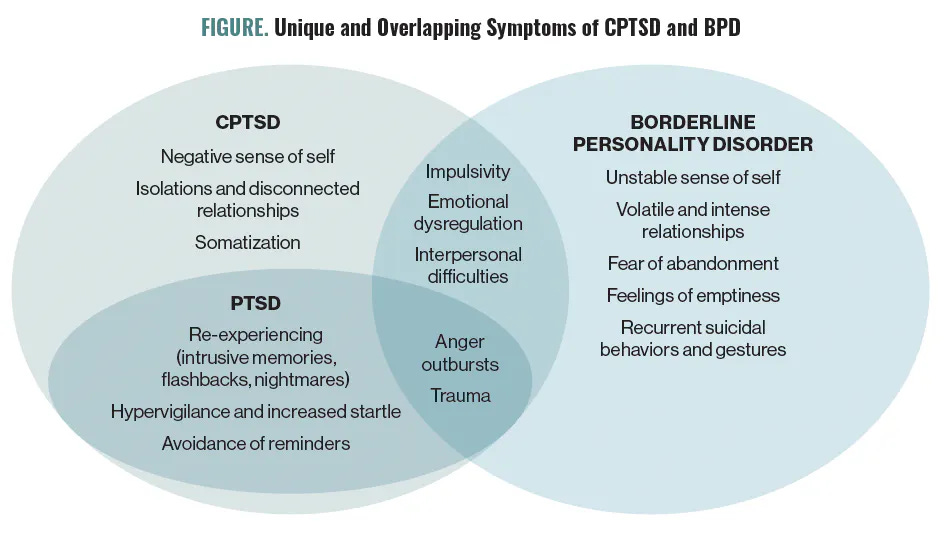
We are asked to believe that “negative sense of self” is somehow different from “unstable sense of self.” “Impulsivity and emotional dysregulation” are apparently not the same as “temper outbursts.” “Isolations and disconnected relationships” differ from “interpersonal difficulties,” while “volatile and intense relationships” are something else again. Similarly, they imply that suicidal thoughts and actions only occur in the personality disorder which, as anybody who has dealt with post-traumatic states knows, is rubbish. The whole thing is a case of six of one, half a dozen of the other. These “differences” are not unique” at all, they are simply artful word games designed to give the impression that the diagnoses are separate and distinct categories when they are not. Doublespeak, in other words. Or bullshit.
They give an example of a 46yo man who has had six separate diagnoses, leading to four different antipsychotic drugs, four “mood stabilisers,” a raft of antidepressants, four drugs for anxiety (including the addictive anticonvulsant drug, gabapentin, FGS) and at least three others, as well as half a dozen different sorts of psychological management. If that doesn’t scream “We don’t know what we’re doing,” nothing does but again, this fact is buried under a flood of jargon and gobbledygook.
Why would anybody bother? What’s wrong with saying “Humans can suffer severe, lasting psychological damage as a result of life experiences”? Because it doesn’t match their model, that’s what. The brilliant British economist, JM Keynes said: “When the facts change, I change my mind. What do you do, sir?” But instead of changing the model, psychiatrists try to change the facts. They try to insist that the disorders are separate and distinct when Blind Freddy can see they are only variations on a single theme. And it isn’t working. Slowly, surely, the biological approach to mental disorder is reaching its use-by date. The only way its shelf-life can be extended is by dollops of doublespeak. Spot the difference in this quote:
With cPTSD, the negative sense of self may manifest as avoidance and disconnection, whereas with BPD, the unstable sense of self may result in a relationship that is volatile and intense.
This is pseudoscientific bullshit, just hollow words designed to conceal the crucial fact: We psychiatrists don’t actually have a theory of mind or a theory of personality, or models of mental disorder or of personality disorder, and we’re running out of ways to keep the pretence going.
Note that I am NOT saying that post-traumatic states don’t exist. They most definitely do and their cause has nothing to do with biology. Any human being can develop disabling and essentially permanent mental symptoms as a reaction to an overwhelming threat, such as civilians trapped in a tiny area and repeatedly bombed. People who get to the top without any mental problems, like Nemeroff, should thank their lucky stars, not their “superior moral strength,” as most of them don’t have it anyway.
References:
1. Frankfurt H (1986). On Bullshit. Raritan Quarterly Review 6 (2): 81–100. (Fall 1986).
https://philpapers.org/rec/FRAOB
2. Lutz, WD. (1989) Doublespeak: From "Revenue Enhancement" to "Terminal Living": How Government, Business, Advertisers, and Others Use Language to Deceive You. Harper & Row, New York.
3. Diagnostic and Statistical Manual of Mental Disorders, 3rd Edition (DSMIII). American Psychiatric Association, 1980.
The whole of this material is copyright but can be copied or retransmitted provided the author is acknowledged.