
In the post from two weeks ago, I reported on an interview on ABC radio which featured the prominent Sydney academic psychiatrist, Prof. Ian Hickie. In it, Hickie commented on the "hysteria" that modern antidepressants (A/Ds) "... in some way have created mass suicidal risk." He continued: "... I'm a co-author of studies in the British Medical Journal and others, at a population level, when increasing antidepressants goes up, suicide in the populations and suicide attempts go down."
This is very important: about 15% of the adult Australian population take A/Ds, addictive drugs with a huge range of serious side effects, so we need to be very clear on whether they're effective. But Hickie's oft-repeated claim, that on a population basis, A/Ds protect against suicide, is manifestly false. We only need to look at the national suicide rates to see that, since their introduction nearly seventy years ago, and particularly over the past thirty years, antidepressant drugs have had no beneficial effect on suicide rates.
Suicide figures for 1907-2022, available from the Australian Institute of Health and Welfare, are crystal clear. Suicides peaked during the Great Depression of the 1930s, dropped to their lowest during World War II (which was also true in the UK and other countries), peaked in the 1960s after the early (and very toxic) antidepressants were introduced, declined again in the 1990s when the SSRI drugs were released, and are now going back up again. This strongly suggests that, on a population basis, the major determinants of suicide are socioeconomic influences, with "biology" having little or no effect. Oh dear.
My memory of the 1970s-80s is that what seemed to be an impulsive "suicidal gesture" suddenly turned lethal just because the tricyclic drugs had such dangerous cardiac side effects. But what counts is that recent widespread prescription of A/D drugs has not resulted in any improvement in the mental health of the nation. Antidepressant drugs are subsidised in this country but regardless of the propaganda we get from the drug companies and their handsomely rewarded academic psychiatrists, the question still remains: Is the community getting value for money for its enormous expenditure on antidepressants? Are individuals better off, are we better off?
A paper published two weeks ago [1] would not have been available to Hickie, which was fortunate for him, because it compares prescription rates for A/Ds and suicide rates in the US for the period 1999-2020. Here is one of their graphs, showing the trends:
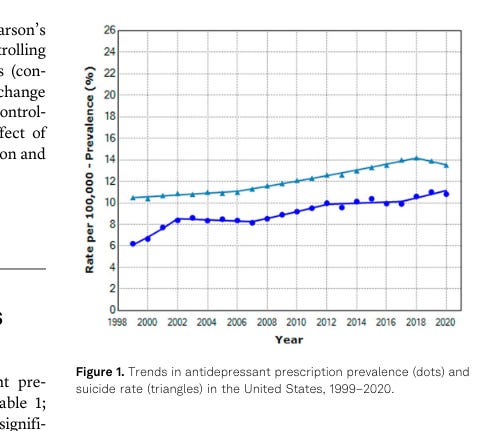
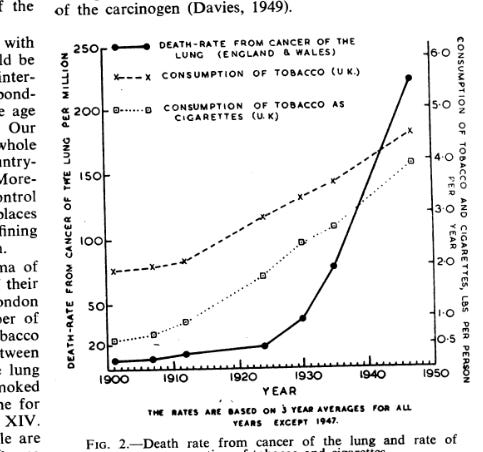
As anybody can see, as the prescription rates go up, so too does the suicide rate. Most importantly, this has been known for years. Yes, this iavs just an association, and association is not causation, but association is strong grounds for suspicion, not for eminent professors to spout "... when increasing antidepressants goes up, suicide in the populations and suicide attempts go down." Compare that graph with one of the classics of public health, the relationship between smoking and lung cancer, published by the epidemiologists Richard Doll and Bradford Hill in 1950. As the consumption of tobacco (in lbs, right side) went up over the fifty year period starting 1900, then, 25 years later, so too did the rate of bronchogenic carcinoma:
Another paper published a few months ago [2] in the prestigious journal, Psychological Medicine, adds to this by showing that A/Ds aren't as safe as the manufacturers would like us to believe. The author, a psychologist with a joint appointment at Singapore's National University and at Harvard, conducted an extensive search of the literature for research papers which provided data on "serious adverse outcomes" in people getting various forms of treatment for depression.
There were 34 papers in the meta-analysis, which compared A/D drugs only, psychotherapy only, or a combination of A/Ds and psychotherapy. Psychotherapy was taken to mean either an insight-directed form of "talking treatment" or the more typical cognitive-behavioral therapy (CBT). Adverse outcomes included hospital contacts or admissions, and suicide bids or successful suicide. Unfortunately, the paper is dense with statistics and the written style is heavy-going but the message is clear: as a matter of health care policy, relying on antidepressant drugs alone puts the patient at greater risk of something going seriously wrong.
I see problems with this paper, starting with the average age of the patients in the various studies: just 32yrs. This is because it included fifteen papers covering adolescents or children only. For myself, the idea of putting young people on a drug and saying "You'll be fine, come back in two weeks," was unacceptable but that's the mainstream. Young people certainly do get depressed, but there's no convincing evidence that their mental troubles are "biological" in nature, or that the advantages of messing with their brain chemistry are guaranteed to heavily outweigh the disadvantages in the short and long term. However, the paper leaves no doubt that talking to young people has a protective role, and it makes good sense. With drugs, the subliminal message is: "It doesn't matter what you think or how miserable your life has been, you've got a chemical imbalance of the brain so you'll be taking drugs for a very long time. Get used to it." That’s not encouraging. With psychotherapy, the message is: "Yes, you're going to get better; no, it's not fatal so don't take any notice of those silly people on TikTok; yes, we can sort it out so let's get started."
How does Hickie square this with his claim that A/Ds reduce suicides? Short answer: he doesn't. As is typical of psychiatry, he will simply ignore the bad news and continue spreading his gospel of joy that chemical salvation awaits all, just stand in line and we'll fix you up. This is institutionalised but I'll contact the good professor to ask his view.
Over the weekend, Melissa Raven, a research psychologist at Adelaide University's Critical and Ethical Mental Health Research Unit (Head: Prof. Jon Jureidini, see here for a sample), circulated the Critical Psychiatry Network with links to two articles (open access, here and here) on the rapidly growing use of puberty blockers in adolescents. The author is Sallie Baxendale PhD, professor of clinical neuropsychology at University College London. We can be fairly sure she earned her position the hard way and didn't wheedle her way into it.
The first article is an interesting, conventional review of published studies of the effects of puberty blockers on cognitive development in teenagers. Bearing in mind the almost explosive increase in prescription of these drugs, the first thing to note is how little we know of their effects on the adolescent brain. The brain is not an inert organ (unless you’re elected to parliament). Around puberty, in particular, there is rapid and, above all, sex-specific development taking place, most of which remains a mystery. People who claim they know how dendritic pruning relates to mental function are talking nonsense: they don't even know how mind and brain relate, so translating poorly-understood physical changes into mental constructs is ridiculous. She listed three key points of the review:
Adolescence is a critical window of neurodevelopment and puberty plays a critical role in these neurodevelomental processes.
The suppression of puberty impacts brain structure and the development of social and cognitive functions in mammals, the effects are complex and often sex specific.
No human studies have systematically explored the neuropsychological impact of pubertal suppression in transgender adolescents with an adequate baseline and follow-up, this is an urgent research priority.
In a nicely-understated conclusion, she flagged a major warning:
Critical questions remain unanswered regarding the nature, extent and permanence of any arrested development of cognitive function associated with puberty blockers. (On t)he impact of pubertal suppression on measures of neuropsychological function ... the evidence base has not kept pace with the growth of the treatment.
So far, so healthily conservative. Before we start prescribing brain-changing drugs, we really ought to be sure they don't, for example, accelerate the development of dementia, which is perfectly feasible. Baxendale's straightforward review showed that there is evidence from animal studies that the drugs involved can induce detrimental effects on brains. Why animal? Because the critical work simply hasn't been done on humans, yet the drugs are being thrown around with gay abandon (actually with medical abandon, which is worse). This is a rerun of the psychosurgery (lobotomy) scandal, the "deep sleep" crimes, "amphetamines for depression," and so many others where whipped up enthusiasm races far ahead of the actual knowledge base. Primum non nocere. First, do no harm. If the research hasn't been done, why have the drugs been released for general use? At a rough guess, Primum pecunias multas faciamus.
That, however, is only part of the story because her second article was in the online paper, Unherd, and asked the very reasonable question: Why did three journals reject my puberty-blocker study? She said:
I have never encountered the kinds of concerns that some of the reviewers expressed in response to my review of puberty blockers. In this case, it wasn’t the methods they objected to, it was the actual findings.
This is not just another unknown author whingeing over getting yet another rejection slip, rejecting an author of her standing is a significant matter. Her review is open access, so everybody should read it and decide whether its message is sufficiently important to be published regardless of a few quibbles (I don't think there are any but we'll allow the possibility). When studying new forms of treatment, we are to err on the side of caution, with which I totally agree, but the journals didn't. They sided with the adventurers and the people making all the money. It is by this process that the scientific literature is slowly but steadily biased. In an essay published nearly twenty years ago, Richard Smith, long-time editor of the British Medical Journal and CEO of publishers BMJ Group, said: "Medical journals are an extension of the marketing arm of pharmaceutical companies." He quoted Richard Horton, editor of the journal Lancet, who said: "Journals have devolved into information-laundering operations for the pharmaceutical industry."
It's not just journals, the profession of psychiatry has wedded itself to Big Pharma (see the MIA article by Jon Jureidini, above), and is fully complicit. People who cheerfully claim that antidepressants lower the suicide rate get free airtime while those who say "Hold on, that just isn't true, and here's the graph to prove it," get nowhere. In the 1960s, the female suicide rate suddenly doubled before declining again to its long-term trend. I'd say that was because women who were prescribed tricyclic antidepressants were not given any information on their toxicity, and so an impulsive overdose became fatal. Antidepressants were not lowering the suicide rate, they were doubling it. Can I prove that? Not at this distance. Do I have to? No, the burden of proving they weren't causing any trouble rests with those who claim that "... when increasing antidepressants goes up, suicide in the populations and suicide attempts go down." It is impossible for Hickie and his good friends in the academic and publishing worlds not to know this. Professors are paid to know. They're also paid to be honest.
In my view, his claim was not a mistake, not a little exaggeration or even a small white lie. It was a falsehood designed to convince the general population that depression is a "real disease with real complications, including dementia, but if you take these harmless little tablets, you'll be fine" when the opposite is true. It is part of the institutional practice of inserting falsehoods into the discourse, to avoid the consequences of the general public knowing the truth about psychiatric treatments [3].
Full disclosure: I rarely prescribed antidepressants during my career, and then mostly for programs for people to get off them. I thought they were unnecessary but I always left the decision to patients. However, I never had to argue with anybody because when they were given the list of the side effects of the drugs, they refused: "Antidepressants are highly addictive and many people end up taking them for decades; they can cause drowsiness and impair concentration so if you're a commercial driver or pilot, if you operate fast machinery or you have access to firearms, you will have to notify your employer; they can cause a severe and untreatable inner agitation which many people describe as torture and can become permanent (akathisia); they cause weight gain, which will be almost impossible to prevent and very difficult to lose later; and they'll wreck your sex life, perhaps permanently. Bearing that in mind, there's no guarantee they'll work much better than placebo, but there's well over 10% risk of a serious side effect called a manic attack which will propel you into the mental hospital. Now, if you still want them ... No? Very sensible, nor would I. So let's start talking, shall we?"
****
Readers may have noted that on February 20th, the sky darkened for several hours, along with distant rumblings and tremors from deep underground, indicating that the Earth had shifted slightly in its orbit. The cause was the exceedingly rare event of the RANZCP issuing an apology, which we will discuss next week.
****
References:
1. Amendola, S., Plöderl, M., & Hengartner, M. P. (2024, February 14). Suicide Rates and Prescription of Antidepressants: Trends in the United States, 1999–2020, by Sex and Race Ethnicity. Crisis: The Journal of Crisis Intervention and Suicide Prevention. Advance online publication. https://dx.doi.org/10.1027/0227-5910/a000941
2. Zainal NH (2023). Is combined antidepressant medication (ADM) and psychotherapy better than either monotherapy at preventing suicide attempts and other psychiatric serious adverse events for depressed patients? A rare events meta-analysis. Psychological Medicine 1–16. https://doi.org/10.1017/S0033291723003306
3. McLaren N (2016). Psychiatry as Bullshit. Ethical Human Psychology and Psychiatry 18: 48-57.
****
This material is copyright but can be copied or quoted on condition the author is acknowledged.
These articles are the highlight of my week!
The article mentions depression causing dementia, which I'm certain has been claimed by the eggheads, though I am wondering if depression pills cause dementia. My concerns are owing to watching the rapid decline of two of my family members. How many depression patients were not given drug treatment in their research??
They claimed similarly about brain damage and schizophrenia when as it turns out was (and still is) their drugs all along.
Sure, though the average psychiatrist can still be on a good wicket! I just had phone call from one of my two medical student daughters - she told me that MRT ( the rebranded HRT - hormone replacement therapy for menopausal women) is now totally safe and can be used freely (i’m exaggerating a bit). Apparently risk of breast cancer and DVT etc all normal with newer studies! I said be very very sceptical as these studies usually done by the drug companies. While symptoms of hot flushes and sleep disturbance can be somewhat annoying, I said that for women in societies like Japan, where healthy diet and the elderly are more valued, very few women report significant menopausal symptoms. I’m sure it’s more to do with the fact that in WEstern Youth obsessed societies for women menopause means “old age” and not being attractive to men anymore - and many husbands maybe running off with younger women at this time when children are also flying out of the home leaving the “empty nest syndrome”.