
These posts explore the themes developed in my monograph, Narcisso-Fascism, which is itself a real-world test of the central concepts of the Biocognitive Model of Mind for psychiatry.
If you like what you read, please click the “like” button at the bottom of the text, it helps spread the posts to new readers. If you want to comment, please use the link at the end rather than email me as they get lost and nobody sees them.
****
A reader said: “I’m not aggressive, I don’t need to be No. 1…”
Precisely my point. The urge to dominate is real, it’s powerful, it’s universal, but it’s not irresistible. It can be turned on and off at will if we choose. We aren’t compelled to give in to the drive to scramble over the person in front of us, we don’t need to be the centre of attention or the object of devotion or to see our enemies’ heads on pikes. We’re not baboons on the veldt, they have little or no control over these types of drives whereas we, Homo sapiens, have free will. Free will says that however I acted a minute ago, I could have acted differently. That, of course, takes us straight into philosophical territory: What could be the mechanism of free will? Do we have it? If so, how does it fit in with the laws of nature, on and on, the sort of endless debate that keeps philosophers in jobs … well, it used to. Nowadays universities have decided they don’t need them and are closing their departments.
These days, it’s all STEM: science, technology, engineering and maths, that’s all we need to produce a productive and well-rounded society. I don’t agree. My view is that everything bad in psychiatry comes directly from an arrogance built upon ignorance. The foundation of modern psychiatry is the firmly held belief that mental disorders will be fully explained as brain disorders, that a full understanding of the brain will tell us everything we need to know about the causes and cures of mental disorder. That’s the arrogance, that we’re so clever we can understand the most complex thing in the known universe using, as Thomas Insel says, the ordinary techniques of laboratory science.
The ignorance comes from the question: is it true that the mind can be reduced to the brain? This is the doctrine of physicalism, aka materialism, an ontological position. It is not a scientific claim because it’s pure opinion, there is no evidence that can settle it. This is the sort of complex question that philosophers have long pondered without reaching a conclusion. I’ve quoted historian and philosopher Richard Carrier before, as the examplar of biological reductionism:
...more and more it appears that all of sociology can be reduced to psychology, all of psychology can be reduced to biology, all of biology can be reduced to chemistry, and all chemistry to physics, which is the study of matter and energy in space-time. Therefore, everything is matter-energy in space-time … So, theoretically, all of sociology and psychology can be described entirely by physics [1, S. III.5.4.2, 5.5] (note that he hedges it with “appears” and “theoretically”).
If you accept his view, then it seems you would be committed to the view known as determinism, the idea that every particle in our bodies is governed entirely by the laws of physics and nothing else. According to those laws, everything that happens in the universe is determined by what went before and can occur in only one possible way. Therefore, free will doesn’t exist, which would play havoc with our concept of a law-governed society. If everything is just matter and energy interacting in the law-governed space-time matrix, we have as much self-control as a rock falling down a slope, meaning all concepts of morality amount to nough. We just think we have free will, and even thinking we have free will was determined at the time of the Big Bang. Carrier gets around this by saying we can have both, that we can have free will in a determinist universe, which is called compatibilism. To me, it’s nonsense but if you like that idea, that’s fine. You have chosen the ontological position of physicalism, and you’re entitled to it. Just remember, though, you can’t prove it. Despite all the intellectual gymnastics of people like Richard Carrier (i.e. people with strong opinions and high verbal facility), reductionism remains a matter of opinion, not of empirical science. Its appeal lies in its simplicity, it relieves people of having to think critically, as philosopher Daniel Stoljar commented:
… we live in an overwhelmingly physicalist or materialist intellectual culture. The result is that, as things currently stand, the standards of argumentation required to persuade someone of the truth of physicalism are much lower than the standards required to persuade someone of its negation. (The point here is a perfectly general one: if you already believe or want something to be true, you are likely to accept fairly low standards of argumentation for its truth) [2].
The other side of the debate is dualism, the belief that the universe has two fundamental aspects of being that have to be reconciled, and that’s a much more difficult case to make. Dualists inherit the problem of dealing with the mind as a non-physical entity. They’re saying the mind is some sort of poltergeist that pokes its fingers in the smoothly running physical universe, yet somehow manages to escape the penalties of being physical itself. This view is definitely not fashionable these days. People constantly find reasons to object to dualism while calmly accepting the peculiarities of physicalism, as philosopher David Oderberg complained:
Dualism... persists in being more the object of ridicule than of serious rational engagement. It is held by the vast majority of philosophers to be anything from (and not mutually exclusively) false, mysterious, and bizarre, to obscurantist, unintelligible, and/or dangerous to morals. Its adherents are assumed to be biased, scientifically ill-informed, motivated by prior theological dogma, cursed by metaphysical anachronism, and/or to have taken leave of their senses. Dualists who otherwise appear relatively sane in their philosophical writings are often treated with a certain benign, quasi-parental indulgence [3].
Impasse: Stoljar says that physicalism is either true but boring, i.e. just an opinion that says nothing new, or interesting but false. If we take physicalism seriously, we end up with oddities such as not having free will, which is taken to mean nobody should be punished for doing bad things. However, if we take dualism seriously, that the mind is a real thing distinct from but able to interact with the body, then not only are you giving yourself a headache but people tend to sidle up and suggest you should take more of the blue pills.
Modern psychiatry has plumped for physicalism without ever working out whether it should. My case is that this is a dangerous path that leads to people with mental problems being treated as, well, insane, fit only to be locked up and drugged [4]. According to the mainstream, there’s no point listening to those people as their minds are addled by chemistry and only chemistry can fix them. Which brings us back to the quote from the reader who said: “I have chosen not to force myself on people, I can handle people thinking I’m wrong or even stupid because I know I’m not.” Is that a matter of free will, of choosing to be rational, or is it chemistry? Is all the wickedness going on in the world today a matter of bad genes taking over or is it because people choose in clear consciousness to attack and kill their neighbours? This is real, this is what philosophy is all about, and this is why we need philosophy departments, except they should be much bigger. We should go back to teaching logic in high school and give every university student an introductory course in philosophy.
Anyway, the reader said: “I don’t need to be No. 1.” The biocognitive model says he made a clear, conscious decision to step back and let other people have a say, and that this is not just a matter of chemistry, of particles bumping in the dark inside the skull. That is, his physiological drive to dominate was switched off as a matter of choice, of free will. The vital point is that if one person can do it, every person can. We do not have to be aggressive, we can live harmoniously if we choose, but it seems a lot of people in power choose not to. Perhaps they should all be on the blue pills.
The biocognitive model for psychiatry is a dualist model [5]. It says the mind is real, functional, cannot be reduced to the brain and does NOT run according to the laws of physics. Carrier was wrong: “all of sociology and psychology” can never be described by physics. Mental life is governed by its own laws which owe nothing to physics, now or at any stage in the past or future. Morality will never be a matter of dumb matter. However, taking the dualist ontological position is the difficult choice. Physicalists just wave their hands and say “Don’t worry about the details, science will deliver them one fine day.” This is called promissory materialism, surely the weakest of all philosophical positions. However, it has lots of supporters because it sounds impressive and silences doubters, all the while requiring zero intellectual effort.
For dualists, far and away the biggest problem is the same one found by Princess Elizabeth of Bohemia, in her lengthy correspondence with the patron saint of dualism, René Descartes (1596-1650). He said: “Mind and body are completely different substances. Mind substance is not related to body substance and vice versa.” She said: “If that’s true, how can they interact?” He replied: “Gimme a break, woman.” Not quite:
... the most ignorant people could, in a quarter of an hour, raise more questions of this kind than the wisest men could deal with in a lifetime; and this is why I have not bothered to answer any of them. These questions presuppose amongst other things an explanation of the union between the soul and the body, which I have not yet dealt with at all (letter to Clersellier, 12 January 1646).
He definitely did not think she was ignorant but unfortunately, he died of pneumonia before he could deal with it, and it hasn’t gone away. The issue is the laws of thermodynamics, which say that if something non-physical interferes in the physical universe, an energy debt will build up until one day, the whole thing explodes. Every argument against dualism comes down to this point: how do different substances interact? I think there is a way around it, and it’s important because it gives us free will. The resolution of the problem is to say that the mind is not a substance. “Oh ho,” scoff the physicalists, “so you’re saying it’s a magical substance that exists and doesn’t exist? Give us a break.” Never give a sucker a break: the problem lies in the word “substance,” which clearly implies a physical basis. However, in his original French, which was later translated to Latin and only then to English, Descartes said: “There is material substance, from which the body is made, and there is thinking substance. Each requires nothing other than itself to exist. I am a thing that thinks.”
The biocognitive model says his error was two fold, in using the term “substance” and in thinking that mind and body are unrelated. It says: “The mind is a non-physical, functional entity that emerges from the body’s activity by rational processes that we can understand.” Those processes are mathematical, not chemical, and they lead to the concept of the mind as an informational state that arises from the brain’s computational capacity. An informational state is nothing more than what we now call IT, the concept of information as something real that can be shipped around the place but doesn’t weigh anything. We know it’s there but we can’t see it. It has no limbs but is able to interact with the physical world. It obeys rules but not the rules of the physical realm. Instead, it is controlled by the rules of its own internal logic which owe nothing to physics, meaning the universe is governed by two sets of rules.This is what dualism actually means: not two substances but two sets of rules, each of which owes nothing to the other. Information doesn’t breach the laws of thermodynamics, so our heads aren’t in danger of blowing up. Finally, one day when our brains wear out and cease to function, so too will our minds.
Note that I use the word “mind” to refer to the activity in the three ring circus in our heads (I presume you have one too but I can’t prove it). Other people like to call it “consciousness” but that’s only to avoid the sort of scorn Oderberg endured by giving it a scientific gloss. Many people like to refer to it as the “soul” or “spirit” or some such term but gives the reductionists something to scorn, because of the implicit notion of immortality or being unbound by any laws - which isn’t actually true but they don’t listen to that bit.
Determinists believe there is only one set of rules in the universe, the rules of physics, which is a bit strange because they all understand and rely on such things as rules of grammar, traffic rules, rules of debate and so on, all of which owe nothing to physics. This points to a major problem with the idea of the mind as information: we are so accustomed to it that we just don’t recognise it. Fish don’t know they live in water. Grasping the idea that we as minded beings are just ephemeral information states is vertiginous I agree, but it clears up a lot of problem, such as free will. Determinists say: “The mind reduces to particles, and particles obey the laws of physics, and free will says we can do things against the laws of physics, therefore free will doesn’t exist.” The biocognitive model says: “We can create in our minds images of past events; there is no reason why we can’t use the same mechanisms to create images of events that haven’t happened; therefore we can generate a range of possible future events, choose from them the one we prefer then make it happen.”
We can’t break physical laws, of course, we can’t reverse gravity or change the past but we can use those laws to expend stored energy (in our muscles, machines, etc) to make something happen that wouldn’t happen by itself. When we build a skyscraper or make an aircraft fly, we’re not doing anything impossible. Computers aren’t magic, even though when I was a child, the idea of thinking machines was pure science fiction. Computers are governed by two sets of laws, the ordinary physical laws relating to electrons speeding around circuits, and the laws of a dual-valued logic, which is the basis of all computation as we know it. An informational state is not a substance and it is definitely not magic. Dualism is real, it is not “false, mysterious, and bizarre, obscurantist, unintelligible, and/or dangerous to morals.”
For psychiatry, the concept of the emergent, information-based mind has two very big advantages. It says we have free will, and it says that what we believe and know is important in deciding how we feel. That is, treatment must be directed at the belief state. Brain chemistry is simply the mechanism by which the emergent informational state of the brain is generated, it is not the mind itself. We can compare the position of mainstream biological psychiatry versus the biocognitive model in this table:
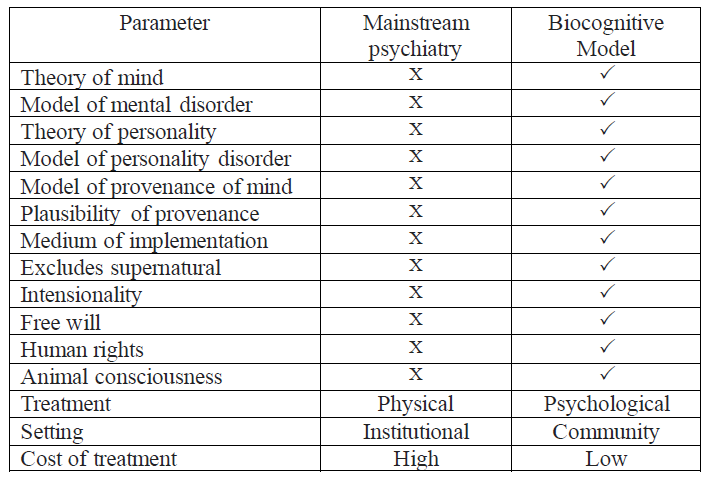
Intensionality refers to the fact that a mental state is directed at something, it has an informational content. I threw in animal consciousness because I think it’s important, partly because there is no evidence to say animals don’t have minds (i.e. the evidence I use to convince myself you have a mind also applies to animals) and partly because of the vast, supremacist conceit behind the idea that we, as the only minded creatures in the known universe, can do what we like to all the others:
So God created man in his own image, in the image of God created he him; male and female created he them. And God blessed them, and God said unto them, Be fruitful, and multiply, and replenish the earth, and subdue it: and have dominion over the fish of the sea, and over the fowl of the air, and over every living thing that moveth upon the earth (Genesis 1: 27-28).
This concept is called dominionism and it is but a short step from believing this twaddle to believing that God has promised certain territories to a particular tribe who are entitled to murder everybody who disagrees.
The project to reduce psychiatry to brain biology has failed to give any interesting material about mental disorder, which is exactly what Daniel Stoljar predicted years ago. All we have to do now is convince the mainstream they should look at alternatives but that’s an uphill battle. Biological psychiatry has the immense appeal of requiring no further intellectual effort than memorising a sentence. Trouble is, it makes psychiatry very boring, which probably explains why so many of them just focus on making heaps of money. An example in Mad in America this week: a pill to mimic the effects of exercise. We’ve already got pills to mimic the effects of eating moderately, so why not have a pill that gives the benefits of exercising without sweating? The authors think they should get more money to research it. Meantime, millions of children around the world are starving. And an article on the widespread bribery in mainstream psychiatry. Tell me again that the world isn’t going to hell on a hang glider.
References:
1. Carrier, R. (2005). Sense and Goodness Without a God: a defence of metaphysical naturalism. Bloomington, IN: AuthorHouse.
2. Stoljar D (2010). Physicalism. Oxford: Routledge.
3. Oderberg DS (2005). Hylemorphic Dualism, in Paul EF, Miller FD, Paul J: Personal Identity. Cambridge: University Press.
4. McLaren N (2024). Theories in Psychiatry: building a post-positivist psychiatry. Ann Arbor, MI: Future Psychiatry Press. Amazon.
5. McLaren N (2021): Natural Dualism and Mental Disorder: The biocognitive model for psychiatry. London: Routledge. Amazon
****
My critical works are best approached in this order:
The case against mainstream psychiatry:
McLaren N (2024). Theories in Psychiatry: building a post-positivist psychiatry. Ann Arbor, MI: Future Psychiatry Press. Amazon (this also covers a range of modern philosophers, showing that their work cannot be extended to account for mental disorder).
Development and justification of the biocognitive model:
McLaren N (2021): Natural Dualism and Mental Disorder: The biocognitive model for psychiatry. London, Routledge. At Amazon.
Clinical application of the biocognitive model:
McLaren N (2018). Anxiety: The Inside Story. Ann Arbor, MI: Future Psychiatry Press. At Amazon.
Testing the biocognitive model in an unrelated field:
McLaren N (2023): Narcisso-Fascism: The psychopathology of right wing extremism. Ann Arbor, MI: Future Psychiatry Press. At Amazon.
The whole of this work is copyright but may be copied or retransmitted provided the author is acknowledged.
Yay - an essay from Dr McLaren on my bday! Life is good. :)
Niall, I could write an even longer essay in reply, although frankly these topics are best discussed over a bottle of wine and a smoke. ;)
"Thinking machines" - was that a Dune reference? <3
Can I ask if you have read Robert Pirsig's 2 fantastic little books - 'Zen and the Art of Motorcycle Maintenance', and 'Lila'? You seem to be VERY close to his positions - but you never mentioned "Quality" so it's not clear.
Well, in Lila he blows Materialist Determinism out of the water with maximum prejudice - and much more importantly, gives rock solid alternatives... without being preachy.
If you HAVE read them, what I'm about to say will be a memory jog, if not I hope to make them attractive to pick up to see what he's/I'm on about.
So ZAMM is pretty much a dualist position, albeit one of the greatest books EVER written. Purest Quality.
But in LILA, the later book, he explores a few other ideals. For one, he switches from the dualist model of ZAMM, and changes gears to the 4(+1) of the ancient pagan model. But he plays with that, and never mentions the theological aspect - because he's not promoting Paganism, but a 4 LAYER REALITY using the same principles.
So there is not just "Mind, and Matter" but other equally important elements too, and by removing those other elements, the model works just as well as a car would without an engine or fuel just the shell and the driver.
I stuck to my dualist guns even through college and degree, and yeah, I've taken the thrown brikbats by overtrained and career-conscious semi-simpletons with their 'simple' claims.
But there are more models of Reality than either egotistical Monotheism, or Zoroastrian-based Dualism, as 'religion' was usually the tool for exploring such fields in history. There is the earth, air, fire, water + spirit of Paganism.
And there is also the 10-fold structure of reality of the Western Qabbalah too, which incorporates to my knowledge everything of all of the above.
Spend a few years with all that rattling around in your head, and then sit down to argue with a Materialist who proclaims only Matter exists, and you'll soon notice they are exactly as wise as a Christian theologist proclaiming "there is only one god, God"... except in reverse.
It is heartbreaking to meet fantastically clever people, who use the most mindbogglingly moronic arguments *Because they have been educated very badly*.
It's actually quite deliberate brainwashing, imo.
Reading back the above, I've realised its a bit choppy, and relies heavily on those two books to make much sense, because sadly I simply don't have the TIME right now to write a proper essay, and find the links/notes to explain it all.
TL;DR no, "It's" not just matter. But nor is "It" probably a dualism either (Apart from the ancient Taoist wisdoms). As Macluhen said, - or was it Leary? - "The Map is not the Territory", rather typically humans are fighting over a map of territory, rather than simply exploring that territory with an open mind.
OH! Before making your eyes bleed with a wall of text, I'll quickly add that Determinism AND Free Will are able to co-exist in the same philosophical framework without clashing.
But this requires a bit of creative thinking.
Consider the meaning of "Infinity" for a few seconds, until you reach the level of insanity required to encompass it.
OK. Now posit that the Universe is actually a Polyverse - there are multiple near-identical Polyverses.
Now posit that EVERY choice that EVERY creature across the Universe makes a separate entire Universe branch. Each time. Now you can see why it's important to be considering what "Infinity" means.
That's the background model, taken to its ultimate extent. (Irl many of the choices could be 'hacked' into a considerably reduced range of universes, but lets leave it at max to keep it simple).
NOW, posit a consciousness that sits astride ALL of these universes, and Time/Space itself - use whatever name for that you want, VALIS, Gawdess, Ego... whatever floats the boat.
That Universal Consciousness is aware of EVERY SINGLE CHOICE YOU COULD POSSIBLY MAKE during this lifetime. Every single choice is played out - including every possible choice of interacting with others.
Still with me on the thought-experiment Doctor?
Now I'm going to do what Einstein/Hawkins did with gravity [wells], reverse the perspective of the common model.
You DO get to choose in this model, whichever your individual path through the maze of choices in your particular experience. Obviously, there is a near-infinite number of Dr Niall McLaren's who chose slightly differently and they went off in their own path in their own Universe within the Polyverse.
But it is ALSO Deterministic, in that every possible choice has been predetermined.
Coming from the DiceMan (Another glorious book!), you give the dice the 6 choices. You can't choose to roll a 7 on one die. The choice is made by the die, but you have determined all possible outcomes.
Anyway, that is one way that free will and determinism can be unified, philosophically.
If anyone should so want to do.
Most people aren't interested in exploring new ideas, they just want to have the ego boost of having the "RIGHT" idea (Or even just argument) which they can smash others down with.
Oh look at that! Ends on the biocognitive model. :D
Good article. A few questions though, two derived from the table comparing your model with psychiatry's.
(1) If your model uses psychological treatment, why should traditional psychiatry exist at all? There should be only psychology, no psychiatry, right?
(2) You're a psychiatrist, I guess. So, following your own model, you don't, ever, prescribe medication (to address psychological problems). Am I right?
(3) Thomas S. Szasz. Was he also critical on psychiatry? Ultimately, did he have his own model?
Thanks